
Think Clearly.
Lead Deliberately.
Navigate What Comes Next.
As your responsibilities grow, leadership can become more complex. The decisions carry greater consequences. The relationships require more judgement. There may be fewer people with whom you can think openly about the challenges you face.
Sometimes, the difficulty is a new role or an unfamiliar level of responsibility. Sometimes, it is a difficult working relationship, a decision with competing priorities, or the recognition that the way you have led successfully in the past may need to evolve.
Executive coaching offers a structured space to examine these challenges and decide how you want to respond. I work with leaders who want to develop greater clarity, understand their habitual patterns of thinking and behaviour, and approach their responsibilities with greater intention.
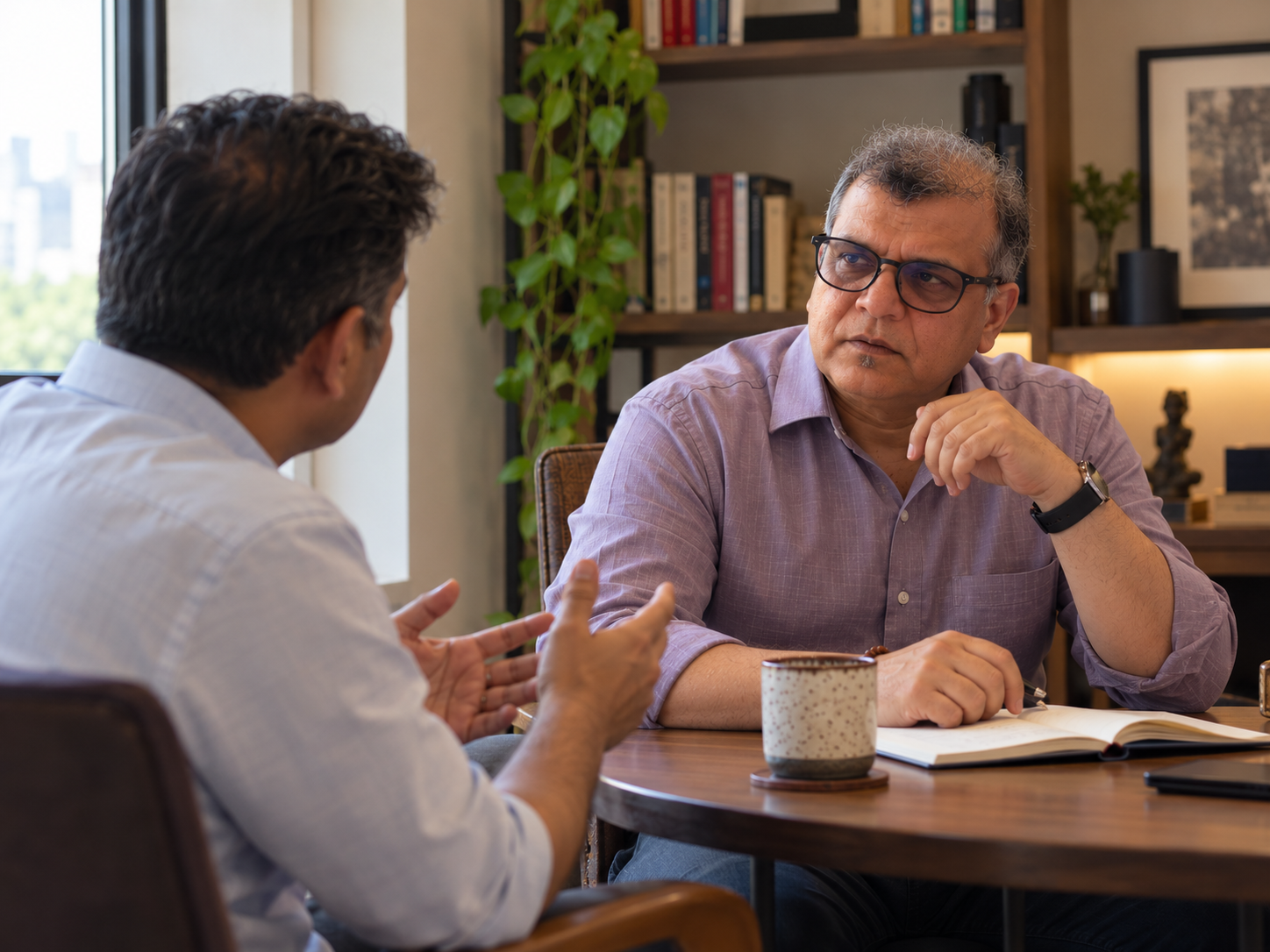
What Brings Leaders to Coaching?
Starting points for inquiry, not assumptions about every person who seeks coaching. The focus of the engagement is determined by your circumstances and objectives.
A new role or leadership transition
You have stepped into a role with different expectations and need to reconsider how you lead, influence and make decisions.
Difficult relationships & conversations
You are dealing with competing perspectives, unresolved tension or conversations that require more care than usual.
Decisions without easy answers
You are balancing priorities, incomplete information and consequences that cannot be fully predicted.
A need to change familiar habits
You recognise patterns in your responses that may have served you in the past but are less useful in your current role.
Achievement without sufficient clarity
Your professional life may be progressing, yet you want to reconsider what matters, how you are spending your energy and what kind of leader you want to become.
What Coaching with Me Involves
Coaching is a collaborative process of inquiry, reflection and action.
Understand your context
We begin by clarifying the situation, what you want to work towards and what makes the challenge important now.
Examine assumptions & patterns
Through structured conversation and reflection, we explore how you are interpreting the situation, what may be influencing your responses and what you may not yet have considered.
Explore different possibilities
We consider alternative perspectives and courses of action, taking account of your responsibilities, relationships and values.
Turn insight into action
We identify practical steps to test between sessions and reflect on what happens when you apply them in real situations.
Coaching is a collaborative process. I do not make decisions on your behalf or promise that every challenge has a simple solution. My role is to help you examine the situation more clearly and develop your own capacity to respond.
The Prajna Perspective
My coaching approach is informed by Prajna and the Human Quotient (HQ), a developmental framework organised around Wisdom, Connection, Adaptability, Curiosity and Meaning.
These dimensions offer different reflective lenses through which to examine leadership:
Wisdom
"What deserves your attention, and what judgement does this situation require?"
Connection
"What perspectives, relationships or conversations need attention?"
Adaptability
"What may need to change in your current approach?"
Curiosity
"Which assumptions deserve to be questioned?"
Meaning
"What matters most in this decision, and what responsibilities follow from it?"
The framework is a resource for reflection, not a rigid formula. Our work remains centred on your circumstances, goals and choices.
Five Powers Self-Diagnostic
Complete this 15-question diagnostic to see your snapshot across Wisdom, Connection, Adaptability, Curiosity, and Meaning.
A Considered, Individual Engagement
Executive coaching is most useful when the goals and expectations are clear enough to guide the work.
If there is a good fit, we can agree on a structured engagement. The specific arrangements are established together rather than assumed in advance.
Coaching conversations are treated with appropriate professional confidentiality, with any boundaries and exceptions discussed at the outset. Where an organisation sponsors the coaching, the expectations around confidentiality, reporting and sponsor communication are agreed before the engagement begins.
Is Executive Coaching Right for You?
Coaching may be appropriate if you are willing to examine your own thinking and behaviour, consider different perspectives and experiment with new approaches.
It is not a substitute for clinical or mental-health care, nor does it remove the need for professional advice in areas outside the scope of coaching.
The first step is a conversation about what you are facing and what you hope to achieve.
Vikas Kaushik
Executive Coaching · Leadership Development
Prajna · Human Quotient (HQ)
Don’t Just Achieve. Become.


